
This extreme value problem has a solution with both a maximum
value and a minimum value. Use Lagrange multipliers to find the
extreme values of the function subject to the given constraint.
(Formulas listed in picture) f(x,y,z)=x(y^2)z
(x^2)+(y^2)+(z^2)=16
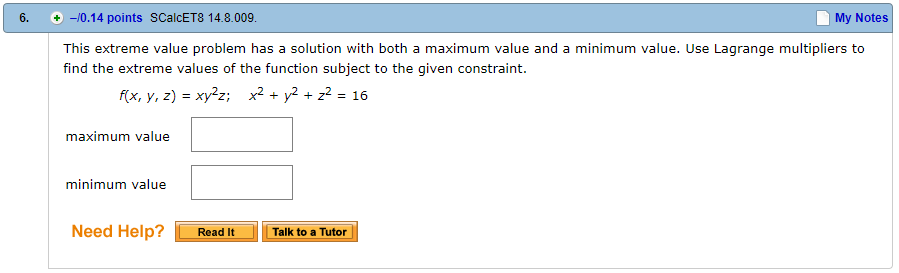
Show transcribed image text 6. -10.14 points SCalcET8 14.8.009 My Notes This extreme value problem has a solution with both a maximum value and a minimum value. Use Lagrange multipliers to find the extreme values of the function subject to the given constraint. rx, y, z) = xy2z; x2 + y2 + z2-16 maximum value minimum value Need Help? Read ItTalk to a Tutor
6. -10.14 points SCalcET8 14.8.009 My Notes This extreme value problem has a solution with both a maximum value and a minimum value. Use Lagrange multipliers to find the extreme values of the function subject to the given constraint. rx, y, z) = xy2z; x2 + y2 + z2-16 maximum value minimum value Need Help? Read ItTalk to a Tutor
ScholarMatic: Explanation & Answer
Your ready answer from a verified tutor is just a click away for as little as $14.99


Click Order Now to get 100% Original Answer Customized to your instructions!