
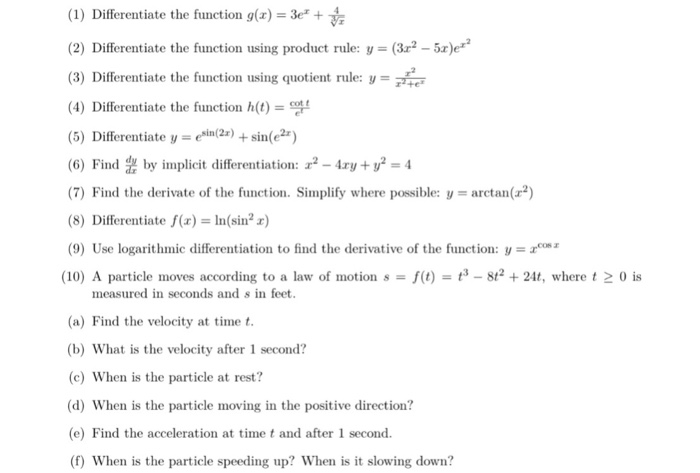
Show transcribed image text (1) Differentiate the function g(x)-3c (2) Differentiate the function using product rule: y = (3r2-5x) 2 (3) Differentiate the function using quotient rule: y = (4) Differentiate the function h(t)- (5) Differentiate y = esin(2x) + sin(e2*) (6) Find溠by implicit differentiation: z2-4xy+92 = 4 (7) Find the derivate of the function. Simplify where possible: y = arctan(H) (8) Differentiate f(x) = ln(sin,) (9) Use logarithmic differentiation to find the derivative of the function: y zcaz (10) A particle moves according to a law of motion s = f(t) = t3-8t2 + 24t, where t 0 is measured in seconds and s in feet (a) Find the velocity at time t (b) What is the velocity after 1 second? (c) When is the particle at rest? (d) When is the particle moving in the positive direction? (e) Find the acceleration at time t and after 1 second. (f) When is the particle speeding up? When is it slowing down?
(1) Differentiate the function g(x)-3c (2) Differentiate the function using product rule: y = (3r2-5x) 2 (3) Differentiate the function using quotient rule: y = (4) Differentiate the function h(t)- (5) Differentiate y = esin(2x) + sin(e2*) (6) Find溠by implicit differentiation: z2-4xy+92 = 4 (7) Find the derivate of the function. Simplify where possible: y = arctan(H) (8) Differentiate f(x) = ln(sin,) (9) Use logarithmic differentiation to find the derivative of the function: y zcaz (10) A particle moves according to a law of motion s = f(t) = t3-8t2 + 24t, where t 0 is measured in seconds and s in feet (a) Find the velocity at time t (b) What is the velocity after 1 second? (c) When is the particle at rest? (d) When is the particle moving in the positive direction? (e) Find the acceleration at time t and after 1 second. (f) When is the particle speeding up? When is it slowing down?
ScholarMatic: Explanation & Answer
Your ready answer from a verified tutor is just a click away for as little as $14.99


Click Order Now to get 100% Original Answer Customized to your instructions!



