

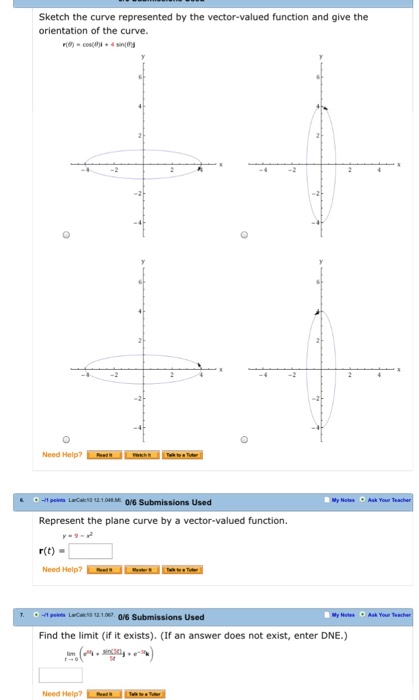
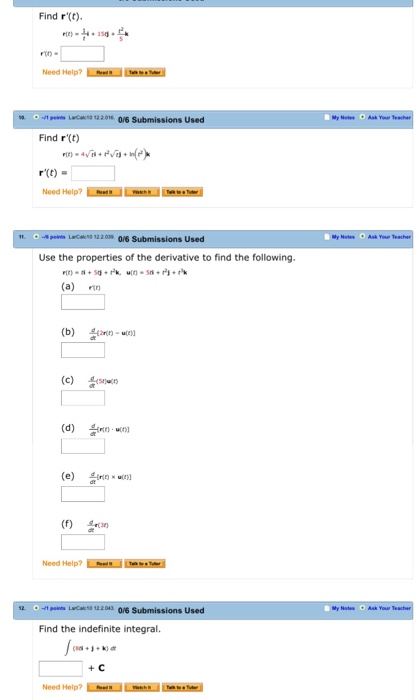
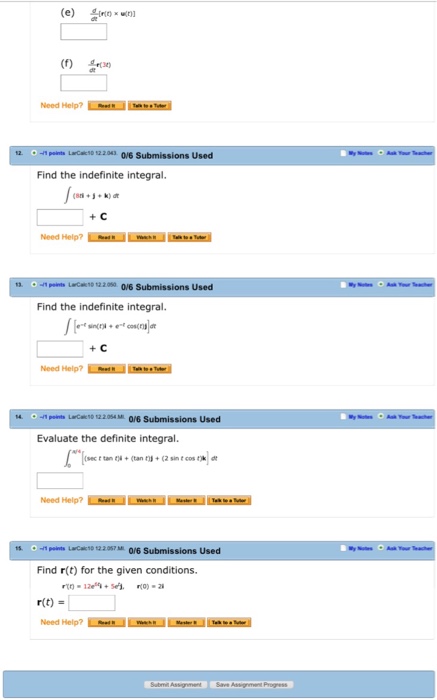
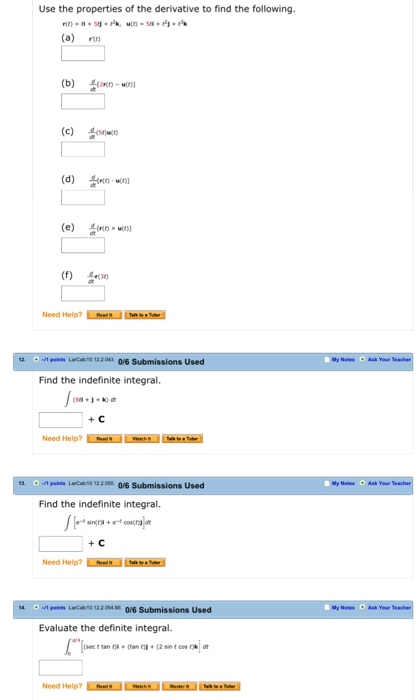
Show transcribed image text Find the domain of the vector-valued function. (Enter your answer using interval notation. (-3,-2)u(-23) x Need Help? peints LaCa1 12,100 O/6 Submissions Used Evaluate (if possible) the vector-valued function at each given value of t. (If you need to use st, enter Deltat.) (a) 甿4). )s+4 peies LaCal 13 121013 0N6 Submissions Used Represent the line segment from P to Q by a vector-valued function. (P corresponds to t = 0, Q corresponds to t = 1 .) 0, 0, 0), Q(9, 3, 2) Represent the line segment from P to Q by a set of parametric equations. (Enter your answers as a comma-separated list.) O/6 Submissions Used My Notes Ask Yo ind t)u(t) Is the result a vector-valued function? Explain. O Yes, the dot product is a vector-valued function. O No, the dot product is a scalar-valued function.
Find the domain of the vector-valued function. (Enter your answer using interval notation. (-3,-2)u(-23) x Need Help? peints LaCa1 12,100 O/6 Submissions Used Evaluate (if possible) the vector-valued function at each given value of t. (If you need to use st, enter Deltat.) (a) 甿4). )s+4 peies LaCal 13 121013 0N6 Submissions Used Represent the line segment from P to Q by a vector-valued function. (P corresponds to t = 0, Q corresponds to t = 1 .) 0, 0, 0), Q(9, 3, 2) Represent the line segment from P to Q by a set of parametric equations. (Enter your answers as a comma-separated list.) O/6 Submissions Used My Notes Ask Yo ind t)u(t) Is the result a vector-valued function? Explain. O Yes, the dot product is a vector-valued function. O No, the dot product is a scalar-valued function.
ScholarMatic: Explanation & Answer
Your ready answer from a verified tutor is just a click away for as little as $14.99


Click Order Now to get 100% Original Answer Customized to your instructions!



