
What’s the answers?
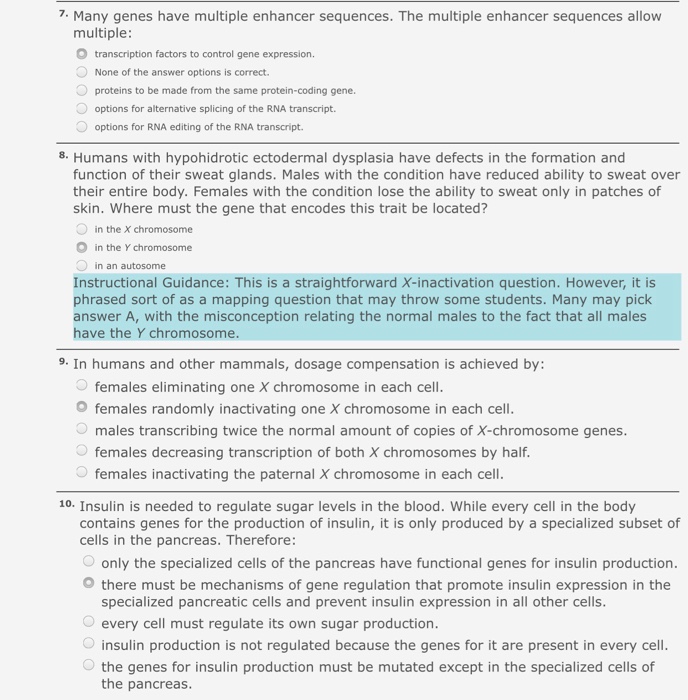
7. Many genes have multiple enhancer sequences. The multiple enhancer sequences allow multiple O transcription factors to control gene expression. None of the answer options is correct. proteins to be made from the same protein-coding gene. options for alternative splicing of the RNA transcript. options for RNA editing of the RNA transcript. 8. Humans with hypohidrotic ectodermal dysplasia have defects in the formation and function of their sweat glands. Males with the condition have reduced ability to sweat over their entire body. Females with the condition lose the ability to sweat only in patches of skin. Where must the gene that encodes this trait be located? in the X chromosome O in the Y chromosome in an autosome Instructional Guidance: This is a straightforward X-inactivation question. However, it is phrased sort of as a mapping question that may throw some students. Many may pick answer A, with the misconception relating the normal males to the fact that all males have the Y chromosome 9. In humans and other mammals, dosage compensation is achieved by: females eliminating one X chromosome in each cell O females randomly inactivating one X chromosome in each cell males transcribing twice the normal amount of copies of X-chromosome genes females decreasing transcription of both X chromosomes by half females inactivating the paternal X chromosome in each cell 10. Insulin is needed to regulate sugar levels in the blood. While every cell in the body contains genes for the production of insulin, it is only produced by a specialized subset of cells in the pancreas. Therefore: only the specialized cells of the pancreas have functional genes for insulin production O there must be mechanisms of gene regulation that promote insulin expression in the specialized pancreatic cells and prevent insulin expression in all other cells every cell must regulate its own sugar production insulin production is not regulated because the genes for it are present in every cell O the genes for insulin production must be mutated except in the specialized cells of the pancreas
ScholarMatic: Explanation & Answer
Your ready answer from a verified tutor is just a click away for as little as $14.99


Click Order Now to get 100% Original Answer Customized to your instructions!



