
Estimating Your Energy and Macronutrients
Needs
4 points. Follow the steps below to calculate your
Estimated Energy Requirements using the following prediction
equations. Use figure 9.10 in page 321 of your textbook to
determine your PA level. Show all steps and calculations.
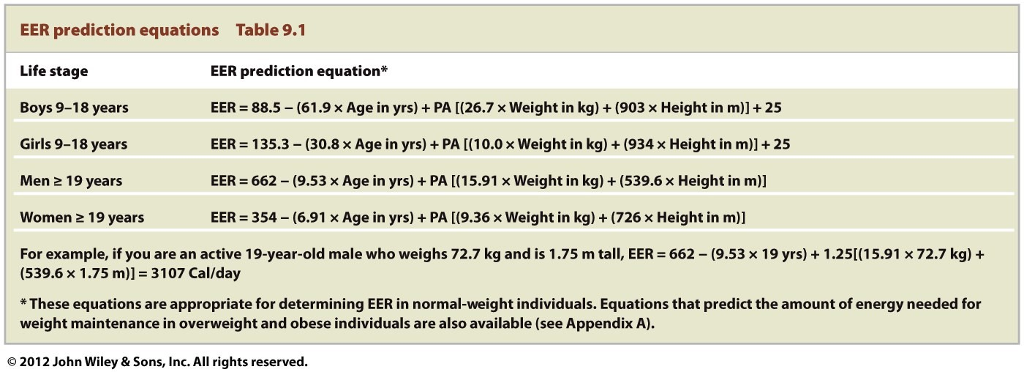
Example: if you are an active (spends at least 60 minutes per
day engaged in moderate-intensity activity (like bicycling
leisurely or hiking, dancing…etc.) or spends at least 30 minutes
in vigorous activity such as tennis, basketball, soccer…etc.)
21-year old woman who weighs 60 kg and is 1.70 m tall, EER = 354 –
(6.91 × 21) + 1.27 [(9.36 × 60 kg) + (726 × 1.7 m)] = 2,489.6
Cal/day
Complete the following:
Your age is: ____________
Your activity level :_______________ Corresponding PA value:
_______________
Your weight in kg: ____________
Your height in meters: ____________
Your EER is (show calculations on the line below):
_____________________Cal/day
__________________________________________________________________________
6 points. You learned in Chapter 2 that the DRIs
include an Acceptable Macronutrient Distribution Range (AMDR) for
carbohydrate, fat, and protein. These ranges ensure adequate intake
of carbohydrate, protein and fat as well as help reduce the risk of
chronic disease. The ranges are wide and support a variety of diet
plans and eating styles. Follow the steps below to compute the
upper and lower limits (in calories and in grams) of your
macronutrients needs.
The Acceptable Macronutrient Distribution (AMDR) for:
Carbohydrate is : _____ to _______% of total calories
Protein is: _____ to _______% of total calories
Fat is: _____ to _______% of total calories
According to the AMDR and my daily caloric needs (use the EER
that you computed above), I would need :
Between _________ and ______________calories from carbohydrates
or between
________grams and
___________________grams of carbohydrates, each day.
Between _________ and ______________calories from proteins or
between
________grams and
___________________grams of proteins, each day.
Between _________ and ______________calories from fats or
between ________grams
and___________________grams of fats,
each day.
Show calculations for carbohydrates
here: ___________________________________
__________________________________________________________________________
__________________________________________________________________________
Show calculations for proteins here:
_________________________________________
___________________________________________________________________________
_____________________________________________________________
__________
Show calculations for fats here:
_________________________________________
_______________________________________________________________________
see more
EER prediction equations Table 9.1 Life stage Boys 9-18 years Girls 9-18 years Menと19 years Women 2 19 years For example, if you are an active 19-year-old male who weighs 727 kg and is 1.75 m tall, EER = 662-(9.53 × 19 yrs) + 1.25(15.91 × 72.7 kg) + EER prediction equation EER-88.5-(61.9 × Age in yrs) + PA [(26.7 x weight in kg) + (903 x Height in m)] + 25 EER = 135.3-(30.8 × Age in yrs) + PA [(10.0 × Weight in kg) + (934 × Height in m)) + 25 EERz 662-(9.53 x Age in yrs) + PA [(15.91 x Weight in kg) + (539.6 × Height in m)] EER = 354-(6.91 × Age in yrs) + PA [(9.36 x weight in kg) + (726 x Height in m)] (539.6 × 1.75 m)] = 3107 Cal/day * These equations are appropriate for determining EER in normal-weight individuals. Equations that predict the amount of energy needed for weight maintenance in overweight and obese individuals are also available (see Appendix A). © 2012 John Wiley & Sons, Inc. All rights reserved.
ScholarMatic: Explanation & Answer
Your ready answer from a verified tutor is just a click away for as little as $14.99


Click Order Now to get 100% Original Answer Customized to your instructions!



