
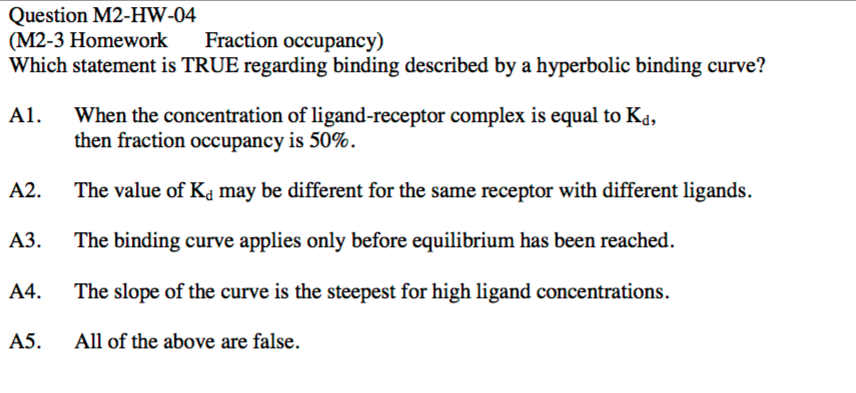
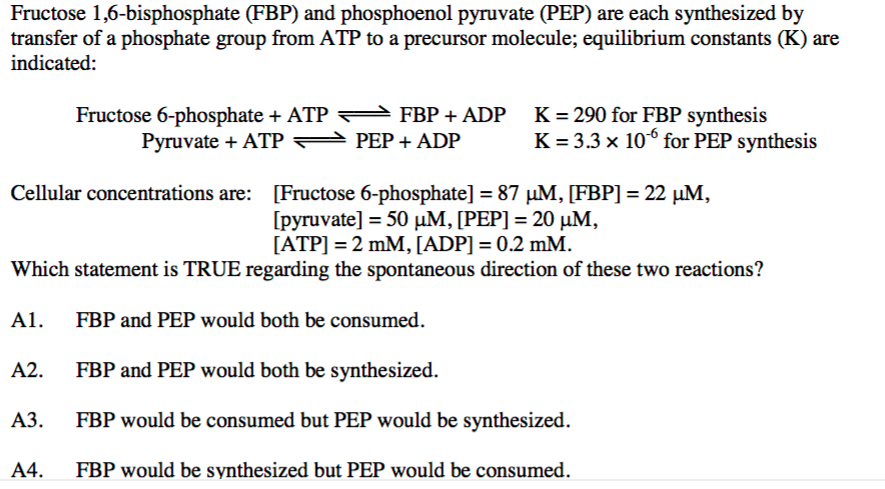
Which statement is TRUE regarding binding described by a hyperbolic binding curve? When the concentration of ligand-receptor complex is equal to K_d, then fraction occupancy is 50%. The value of K_d may be different for the same receptor with different ligands. The binding curve applies only before equilibrium has been reached. The slope of the curve is the steepest for high ligand concentrations. All of the above are false. Fructose 1, 6-bisphosphate (FBP) and phosphoenol pyruvate (PEP) are each synthesized by transfer of a phosphate group from ATP to a precursor molecule; equilibrium constants (K) are indicated: Fructose 6-phosphate + ATP Equilibrium FBP + ADP K = 290 for FBP synthesis Pyruvate + ATP Equilibrium PEP + ADP K = 3.3 times 10^-6 for PEP synthesis Cellular concentrations are: [Fructose 6-phosphate] = 87 mu M, [FBP] = 22 mu M, [pyruvate] = 50 mu M, [PEP] = 20 mu M, [ATP] = 2mM, [ADP] = 0.2 mM. Which statement is TRUE regarding the spontaneous direction of these two reactions? FBP and PEP would both be consumed. FBP and PEP would both be synthesized. FBP would be consumed but PEP would be synthesized. FBP would be synthesized but PEP would be consumed.
ScholarMatic: Explanation & Answer
Your ready answer from a verified tutor is just a click away for as little as $14.99


Click Order Now to get 100% Original Answer Customized to your instructions!



