
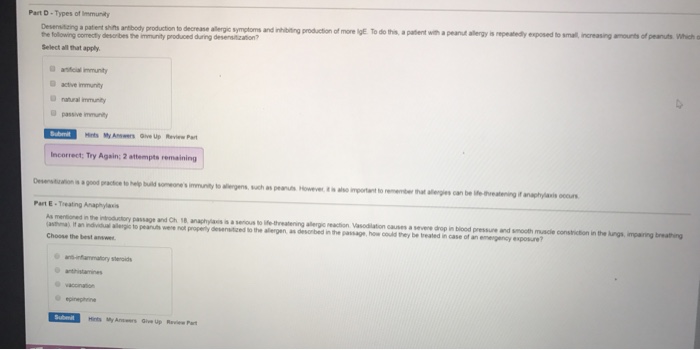
Part D – Types of Immunity
Desensitizing a patient shifts antibody production to decrease
allergic symptoms and inhibiting production of more IgE. To do
this, a patient with a peanut allergy is repeatedly exposed to
small, increasing amounts of peanuts. Which of the following
correctly describes the immunity produced during
desensitization?
Select all that apply.
| 1. artificial immunity |
| 2. active immunity |
| 3.natural immunity |
| 4.passive immunity |
Desensitization is a good practice to help build someone’s
immunity to allergens, such as peanuts. However, it is also
important to remember that allergies can be life-threatening if
anaphylaxis occurs.
Part E – Treating Anaphylaxis
As mentioned in the introductory passage and Ch. 18, anaphylaxis
is a serious to life-threatening allergic reaction. Vasodilation
causes a severe drop in blood pressure and smooth muscle
constriction in the lungs, impairing breathing (asthma). If an
individual allergic to peanuts were not properly desensitized to
the allergen, as described in the passage, how could they be
treated in case of an emergency exposure?
Choose the best answer.
| 1. anti-inflammatory steroids |
| 2. antihistamines |
| 3. vaccination |
| 4. epinephrine |
Part D-Types of Immunity he owing comecty desorbeste immunity produced during desensitzaton and producton of more gE To this a patent wmapeanut alergy repeate reposed osmatincreasing amounts peanuts Select all mat apply. manual immunty passive immunity Hints MAnswers Give up Review Part Incorrect: Try Again: 2 attempts remaining Part E-Treating Anaphylaxis As mentioned eintoautory passage and Ch anaphyaes is a serous to Methreatening alergereaction wsodatnon causes a severe dopin bood pressure and smooth muscle consticton in the kngs, imparing breathing Choose Itanindvaa alergeio peanut not alergen as desorbed inthepassage,hoe could Pey teated incase the best answer. arsinnammatory steroids
ScholarMatic: Explanation & Answer
Your ready answer from a verified tutor is just a click away for as little as $14.99


Click Order Now to get 100% Original Answer Customized to your instructions!



