
1. In an erythrocyte(RBC) undergoing glycolysis, how would a sudden
increase(+) or decrease (-) in the concentration of each of the
following influence glycolysis in the RBC?
A) (+) ATP
B) (+) AMP
C) (-) Citrate
D) (+) Fructose-2,6-biphophate
E) (-) Fructose-1,6-biphosphate
F) (-) pO_2
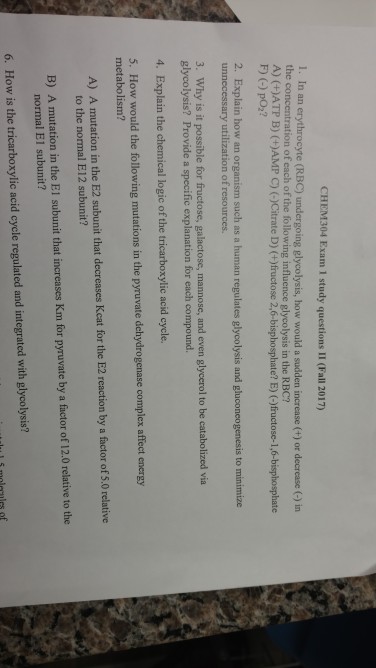
CHEM304 Exam 1 study questions II (Fall 2017) 1 . In an erythrocyte (RBC) undergoing glycolysis, how would a sudden increase (+) or decrease Θ in the concentration of each of the following influence glycolysis in the RBC? A) ATP B) (G)AMP O) )Citrate D) (+)fructose 2,6-bisphosphate? E) +)fructose-1,6-bisphosphate F) (-) pO? 2. Explain how an organism such as a human regulates glycolysis and gluconeogenesis to minimize unnecessary utilization of resources. 3. Why is it possible for fructose, galactose, mannose, and even glycerol to be catabolized via glycolysis? Provide a specific explanation for each compound. 4. Explain the chemical logic of the tricarboxylic acid cycle. 5. How would the following mutations in the pyruvate dehydrogenase complex affect energy metabolism? A mutation in the E2 subunit that decreases Kcat for the E2 reaction by a factor of 5.0 relative to the normal E12 subunit? A) B) A mutation in the E1 subunit that increases Km for pyruvate by a factor of 12.0 relative to the normal E1 subunit? 6. How is the tricarboxylic acid cycle regulated and integrated with glycolysis?
ScholarMatic: Explanation & Answer
Your ready answer from a verified tutor is just a click away for as little as $14.99


Click Order Now to get 100% Original Answer Customized to your instructions!



