
Please only do problem 11. Problem 10 is there for the equations
required for problem 11. Thank you!
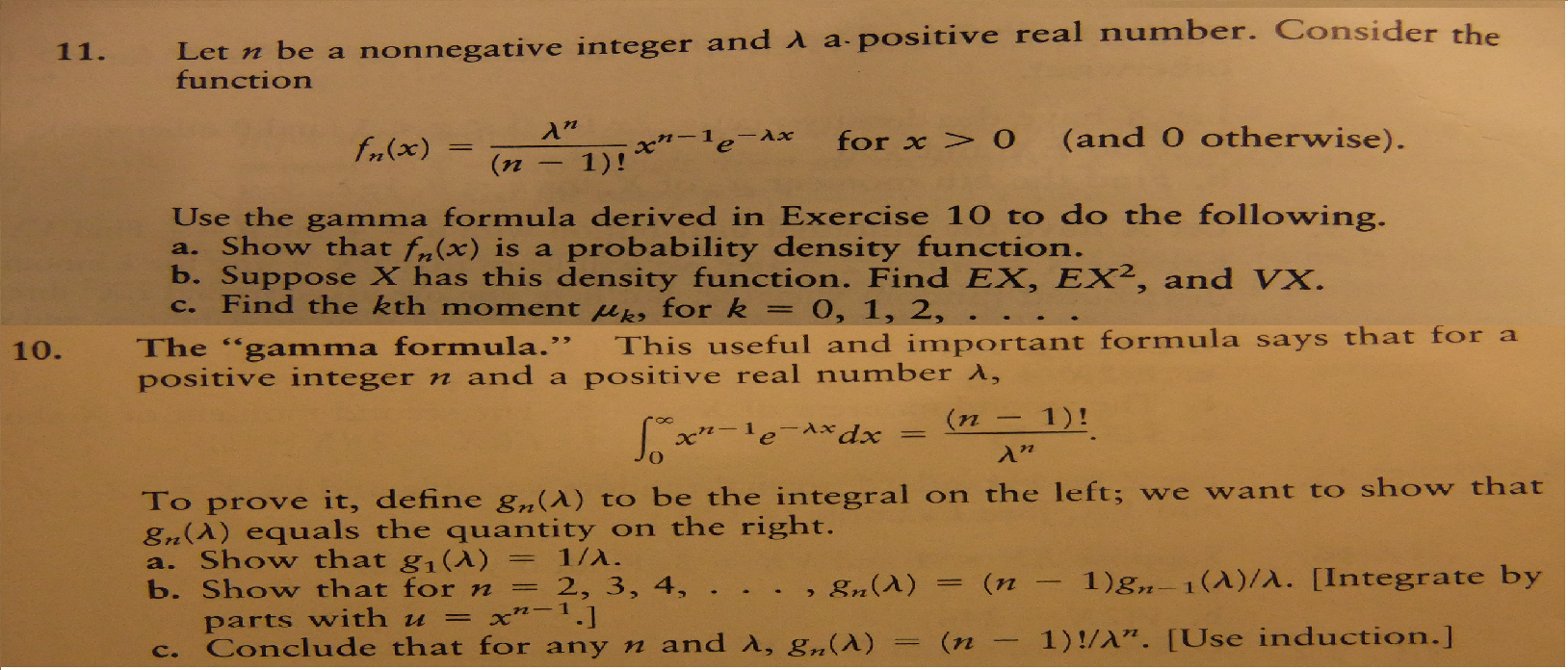
Show transcribed image text 11. Let n be a nonnegative integer and lambda a-positive real number. Consider the function Use the gamma formula derived in Exercise 10 to do the following. a. Show that fn(x) is a probability density function. b. Suppose kth has this density function. Find EX, EX^2, and VX. c. Find the kth moment mu k for k = 0, 1, 2, . . . 10. The gamma formula. This useful and important formula says that for a positive integer n and a positive real number lambda, To prove it, define gn(lambda) to be the integral on the left; we want to show that gn(lambda) equals the quantity on the right. a. Show that g1(lambda) = 1/ lambda. b. Show that for n = 2, 3, 4, . . . , gn(lambda) = (n – 1)gn – 1(lambda)/ lambda. [Integrate by parts with u = x^n-1.] c. Conclude that for any n and lambda, gn(lambda) = (n – 1)!/ lambda^n. [Use induction.]
11. Let n be a nonnegative integer and lambda a-positive real number. Consider the function Use the gamma formula derived in Exercise 10 to do the following. a. Show that fn(x) is a probability density function. b. Suppose kth has this density function. Find EX, EX^2, and VX. c. Find the kth moment mu k for k = 0, 1, 2, . . . 10. The gamma formula. This useful and important formula says that for a positive integer n and a positive real number lambda, To prove it, define gn(lambda) to be the integral on the left; we want to show that gn(lambda) equals the quantity on the right. a. Show that g1(lambda) = 1/ lambda. b. Show that for n = 2, 3, 4, . . . , gn(lambda) = (n – 1)gn – 1(lambda)/ lambda. [Integrate by parts with u = x^n-1.] c. Conclude that for any n and lambda, gn(lambda) = (n – 1)!/ lambda^n. [Use induction.]
ScholarMatic: Explanation & Answer
Your ready answer from a verified tutor is just a click away for as little as $14.99


Click Order Now to get 100% Original Answer Customized to your instructions!



