
I need help with 1-12
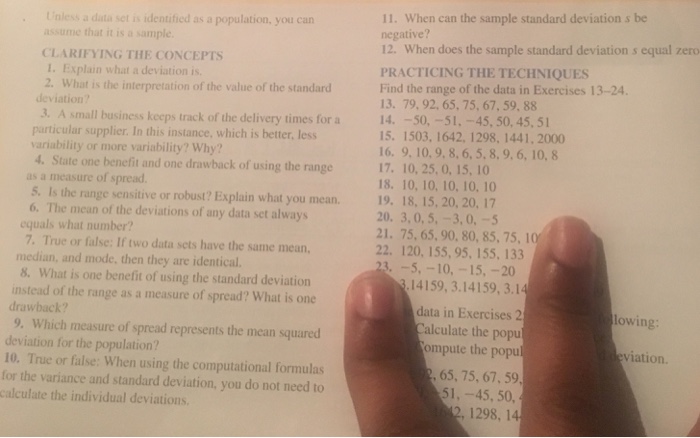
Show transcribed image text 11. When can the sample standard deviation s be negative? 12. When does the sample standard deviation s equal zero PRACTICING THE TECHNIQUES Find the range of the data in Exercises 13-24. 13. 79,92, 65, 75, 67, 59, 88 14. -50,-51, -45, 50,45, 51 15. 1503, 1642, 1298, 1441, 2000 16. 9.10,9,8,6,5,8,9,6, 10, 8 17. 10, 25, 0, 15, 10 18. 10, 10, 10, 10, 10 19. 18, 15, 20, 20, 17 0. 3,0,5, -3,0,-5 21. 75, 65, 90,80,85,75, 1 22. 120, 155, 95, 155, 133 3. -5,-10,-15,-20 Unless a data set is identified as a population, you can assume that it is a sample CLARIFYING THE CONCEPTS 1. Explain what a deviation is. 2. What is the interpretation of the value of the standard deviation? 3. A small business keeps track of the delivery times for a particular supplier. In this instance, which is better, less variability or more variability? Why? 4. State one benefit and one drawback of using the range as a measure of spread is the range sensitive or robust? Explain what you mean equals what number? median, and mode, then they are identical. 6. The mean of the deviations of any data set always 7. True or false: If two data sets have the same mean. 8. What is one benefit of using the standard deviation instead of the range as a measure of spread? What is one 9. Which measure of spread represents the mean squared 10. True or false: When using the computational formulas 14159, 3.14159, 3.1 data in Exercises 2 alculate the popu ompute the popu 65, 75, 67, 59 51,-45, 50, 1298, 14 lowing: drawback? deviation for the population? calculate the individual deviations viation. for the variance and standard deviation, you do not need to
11. When can the sample standard deviation s be negative? 12. When does the sample standard deviation s equal zero PRACTICING THE TECHNIQUES Find the range of the data in Exercises 13-24. 13. 79,92, 65, 75, 67, 59, 88 14. -50,-51, -45, 50,45, 51 15. 1503, 1642, 1298, 1441, 2000 16. 9.10,9,8,6,5,8,9,6, 10, 8 17. 10, 25, 0, 15, 10 18. 10, 10, 10, 10, 10 19. 18, 15, 20, 20, 17 0. 3,0,5, -3,0,-5 21. 75, 65, 90,80,85,75, 1 22. 120, 155, 95, 155, 133 3. -5,-10,-15,-20 Unless a data set is identified as a population, you can assume that it is a sample CLARIFYING THE CONCEPTS 1. Explain what a deviation is. 2. What is the interpretation of the value of the standard deviation? 3. A small business keeps track of the delivery times for a particular supplier. In this instance, which is better, less variability or more variability? Why? 4. State one benefit and one drawback of using the range as a measure of spread is the range sensitive or robust? Explain what you mean equals what number? median, and mode, then they are identical. 6. The mean of the deviations of any data set always 7. True or false: If two data sets have the same mean. 8. What is one benefit of using the standard deviation instead of the range as a measure of spread? What is one 9. Which measure of spread represents the mean squared 10. True or false: When using the computational formulas 14159, 3.14159, 3.1 data in Exercises 2 alculate the popu ompute the popu 65, 75, 67, 59 51,-45, 50, 1298, 14 lowing: drawback? deviation for the population? calculate the individual deviations viation. for the variance and standard deviation, you do not need to
ScholarMatic: Explanation & Answer
Your ready answer from a verified tutor is just a click away for as little as $14.99


Click Order Now to get 100% Original Answer Customized to your instructions!



