
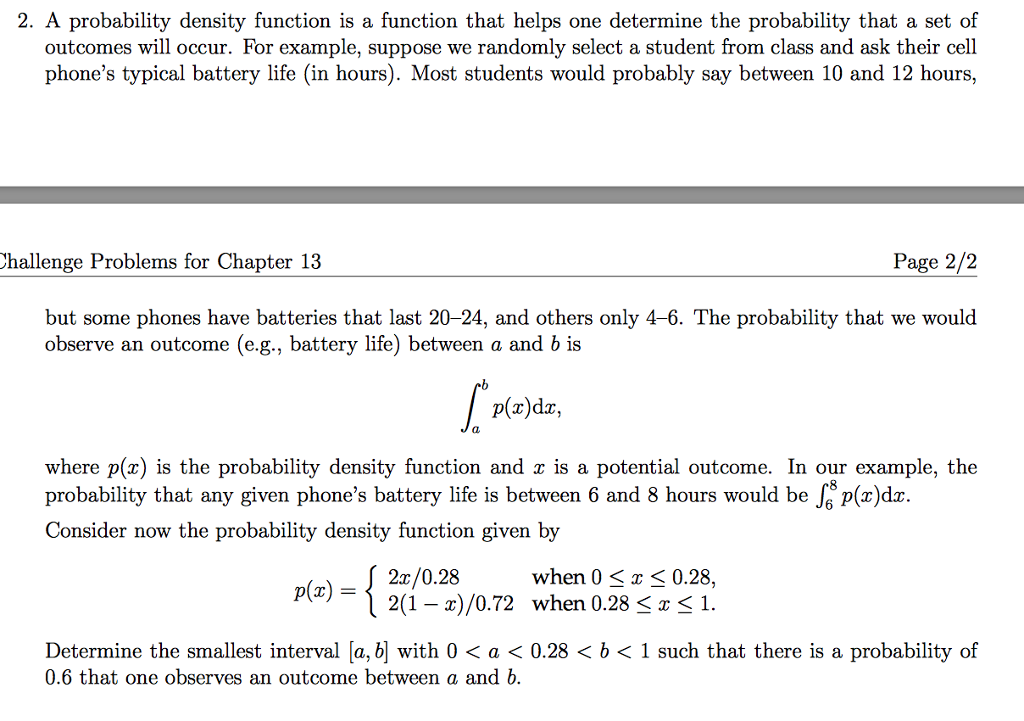
Show transcribed image text 2. A probability density function is a function that helps one determine the probability that a set of outcomes will occur. For example, suppose we randomly select a student from class and ask their cell phones typical battery life (in hours). Most students would probably say between 10 and 12 hours, Challenge Problems for Chapter 13 Page 2/2 but some phones have batteries that last 20–24, and others only 4–6. The probability that we would observe an outcome (eg, battery life) between a and b is p(x)d., a where p() is the probability density function and T is a potential outcome. In our example, the probability that any given phone's battery life is between 6 and 8 hours would be sº p(1)dr Consider now the probability density function given by 2/0.28 when 0
2. A probability density function is a function that helps one determine the probability that a set of outcomes will occur. For example, suppose we randomly select a student from class and ask their cell phones typical battery life (in hours). Most students would probably say between 10 and 12 hours, Challenge Problems for Chapter 13 Page 2/2 but some phones have batteries that last 20–24, and others only 4–6. The probability that we would observe an outcome (eg, battery life) between a and b is p(x)d., a where p() is the probability density function and T is a potential outcome. In our example, the probability that any given phone's battery life is between 6 and 8 hours would be sº p(1)dr Consider now the probability density function given by 2/0.28 when 0
ScholarMatic: Explanation & Answer
Your ready answer from a verified tutor is just a click away for as little as $14.99


Click Order Now to get 100% Original Answer Customized to your instructions!



