
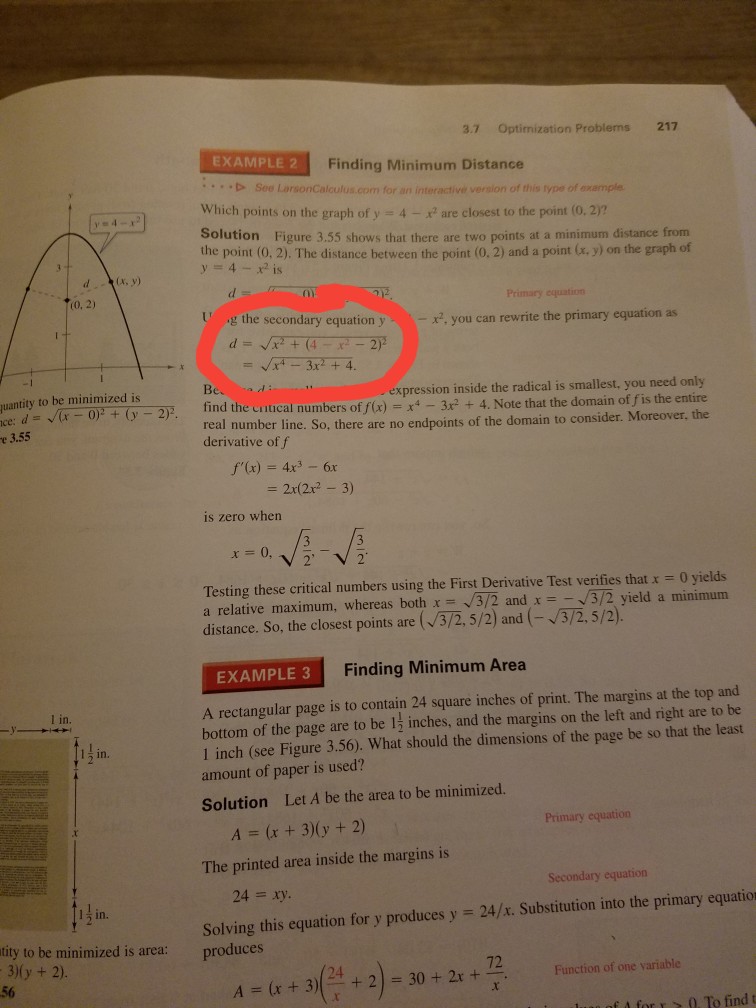
please explain how the circled simplification works step by
step.
Show transcribed image text 3.7 Optimization Problems 217 EXAMPLE 2 Finding Minimum Distance .D See LarsonCalculus.com for an interactive version of this type of example which points on the graph of y 4-x2 are closest to the point (0,2)? Solution Figure 3.55 shows that there are two points at a minimum distance from the point (0, 2). The distance between the point (0, 2) and a point (x, y) on the graph of y=4 IS 0, 2) U ·g the secondary equation y x2, you can rewrite the primary equation as Be uantity to be minimized is ice: d = v/ (X-())2+(vー2)2. e 3.55 expression inside the radical is smallest, you need only find the citical numbers off(x) =x4-3×2 + 4. Note that the domain offs the entire real number line. So, there are no endpoints of the domain to consider. Moreover, the derivative of f f(x) 4×3-6x = 2t(2×2-3) is zero when Testing these critical numbers using the First Derivative Test verifies that 0 yields a relative maximum, whereas both X v/3/2 and x = /3 2 yield a minimum distance. So, the closest points are (3/2, 5/2) and(-3/2,5/2). EXAMPLE 3 Finding Minimum Area A rectangular page is to contain 24 square inches of print. The margins at the top and bottom of the page are to be l inches, and the margins on the left and right are to be 1 inch (see Figure 3.56). What should the dimensions of the page be so that the least amount of paper is used? Solution Let A be the area to be minimized. l in 1Jin. Primary equation A = (x + 3)(y + 2) The printed area inside the margins is Secondary equation 24 xy. 1 5 in. 24/x. Substitution into the primary equatio Solving this equation for y produces y tity to be minimized is area: produces A=(x+3)( 24 + 2)=30 + 2x + Function of one variable 56 luae of d forr 3 0. To findt t
3.7 Optimization Problems 217 EXAMPLE 2 Finding Minimum Distance .D See LarsonCalculus.com for an interactive version of this type of example which points on the graph of y 4-x2 are closest to the point (0,2)? Solution Figure 3.55 shows that there are two points at a minimum distance from the point (0, 2). The distance between the point (0, 2) and a point (x, y) on the graph of y=4 IS 0, 2) U ·g the secondary equation y x2, you can rewrite the primary equation as Be uantity to be minimized is ice: d = v/ (X-())2+(vー2)2. e 3.55 expression inside the radical is smallest, you need only find the citical numbers off(x) =x4-3×2 + 4. Note that the domain offs the entire real number line. So, there are no endpoints of the domain to consider. Moreover, the derivative of f f(x) 4×3-6x = 2t(2×2-3) is zero when Testing these critical numbers using the First Derivative Test verifies that 0 yields a relative maximum, whereas both X v/3/2 and x = /3 2 yield a minimum distance. So, the closest points are (3/2, 5/2) and(-3/2,5/2). EXAMPLE 3 Finding Minimum Area A rectangular page is to contain 24 square inches of print. The margins at the top and bottom of the page are to be l inches, and the margins on the left and right are to be 1 inch (see Figure 3.56). What should the dimensions of the page be so that the least amount of paper is used? Solution Let A be the area to be minimized. l in 1Jin. Primary equation A = (x + 3)(y + 2) The printed area inside the margins is Secondary equation 24 xy. 1 5 in. 24/x. Substitution into the primary equatio Solving this equation for y produces y tity to be minimized is area: produces A=(x+3)( 24 + 2)=30 + 2x + Function of one variable 56 luae of d forr 3 0. To findt t
ScholarMatic: Explanation & Answer
Your ready answer from a verified tutor is just a click away for as little as $14.99


Click Order Now to get 100% Original Answer Customized to your instructions!



