
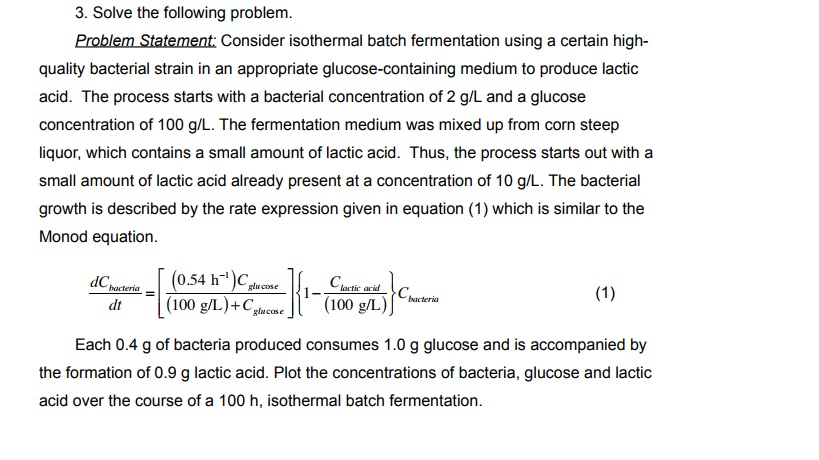
Show transcribed image text 3. Solve the following problem. Problem Statement: Consider isothermal batch fermentation using a certain high- quality bacterial strain in an appropriate glucose-containing medium to produce lactic acid. The process starts with a bacterial concentration of 2 g/L and a glucose concentration of 100 g/L. The fermentation medium was mixed up from corn steep liquor, which contains a small amount of lactic acid. Thus, the process starts out with a small amount of lactic acid already present at a concentration of 10 g/L. The bacterial growth is described by the rate expression given in equation (1) which is similar to the Monod equation. 「 (0.54 h-ljcgl"cost L(100 g/L)-Cglucose」1 dC dt (100 g/L Each 0.4 g of bacteria produced consumes 1.0 g glucose and is accompanied by the formation of 0.9 g lactic acid. Plot the concentrations of bacteria, glucose and lactic acid over the course of a 100 h, isothermal batch fermentation
3. Solve the following problem. Problem Statement: Consider isothermal batch fermentation using a certain high- quality bacterial strain in an appropriate glucose-containing medium to produce lactic acid. The process starts with a bacterial concentration of 2 g/L and a glucose concentration of 100 g/L. The fermentation medium was mixed up from corn steep liquor, which contains a small amount of lactic acid. Thus, the process starts out with a small amount of lactic acid already present at a concentration of 10 g/L. The bacterial growth is described by the rate expression given in equation (1) which is similar to the Monod equation. 「 (0.54 h-ljcgl"cost L(100 g/L)-Cglucose」1 dC dt (100 g/L Each 0.4 g of bacteria produced consumes 1.0 g glucose and is accompanied by the formation of 0.9 g lactic acid. Plot the concentrations of bacteria, glucose and lactic acid over the course of a 100 h, isothermal batch fermentation
ScholarMatic: Explanation & Answer
Your ready answer from a verified tutor is just a click away for as little as $14.99


Click Order Now to get 100% Original Answer Customized to your instructions!



