
a). Use a suitable integration method to compute the Laplace
transform for the function
f(t) = e^(at)
without using the tables in the formula sheet.
Be sure to state, with reasons, the allowed range for s for
which the Laplace transform exists.
b). Use the result from part (a) to deduce the Laplace transform
for t*e^(at). Do not use the formula sheet.
c). Suppose y(t) is a solution of the following ordinary
differential equation
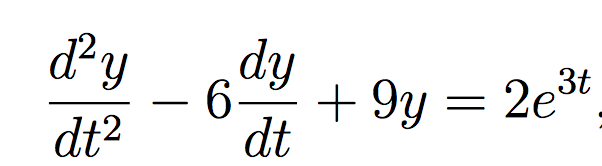
and that y = 0 and dy/dt = 1 at t = 0.
Let Y (s) be the Laplace transform of y(t). Write down an
algebraic equation for Y (s). Hence solve for Y (s) in terms of s.
Do not try to factor the result nor split it into partial
fractions.
d). Using either your results form parts (a) and (b) or by use
of the tables, obtain the solution for y(t).
Show transcribed image text 2 dt2 dt
2 dt2 dt
ScholarMatic: Explanation & Answer
Your ready answer from a verified tutor is just a click away for as little as $14.99


Click Order Now to get 100% Original Answer Customized to your instructions!



