
answer part
E,F,G,H,I,J,K,L,M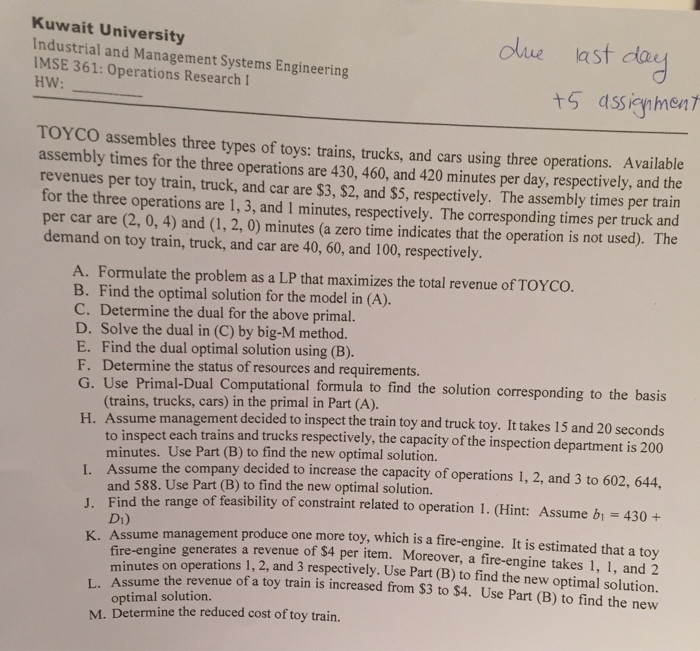
Show transcribed image text TOYCO assembles three types of toys: trains, trucks, and cars using three operations. Available assembly times for the three operations are 430,460, and 420 minutes per day, respectively, and the revenues per toy train, truck, and car are $3, $2, and $5, respectively. The assembly times per train for the three operations are 1,3, and 1 minutes, respectively. The corresponding times per truck and per car are (2, 0, 4) and (1, 2, 0) minutes (a zero time indicates that the operation is not used). The demand on toy train, truck, and car are 40, 60, and 100, respectively. Formulate the problem as a LP that maximizes the total revenue of TOYCO. Find the optimal solution for the model in (A). Determine the dual for the above primal. Solve the dual in (C) by big-M method. Find the dual optimal solution using (B). Determine the status of resources and requirements. Use Primal-Dual Computational formula to find the solution corresponding to the basis (trains, trucks, cars) in the primal in Part (A). Assume management decided to inspect the train toy and truck toy. It takes 15 and 20 seconds to inspect each trains and trucks respectively, the capacity of the inspection department is 200 minutes Use Part (B) to find the new optimal solution. Assume the company decided to increase the capacity of operations 1, 2, and 3 to 602, 644, and 588 Use Part (B) to find the new optimal solution. Find the range of feasibility of constraint related to operation 1. Assume management produce one more toy, which is a fire-engine. It is estimated that a toy fire-engine generates a revenue of $4 per item. Moreover, a fire-engine takes 1, 1, and 2 minutes on operations 1, 2, and 3 respectively. Use Part (B) to find the new optimal solution. Assume the revenue of a toy train is increased from $3 to $4. Use Part (B) to find the new optimal solution. Determine the reduced cost of toy train.
TOYCO assembles three types of toys: trains, trucks, and cars using three operations. Available assembly times for the three operations are 430,460, and 420 minutes per day, respectively, and the revenues per toy train, truck, and car are $3, $2, and $5, respectively. The assembly times per train for the three operations are 1,3, and 1 minutes, respectively. The corresponding times per truck and per car are (2, 0, 4) and (1, 2, 0) minutes (a zero time indicates that the operation is not used). The demand on toy train, truck, and car are 40, 60, and 100, respectively. Formulate the problem as a LP that maximizes the total revenue of TOYCO. Find the optimal solution for the model in (A). Determine the dual for the above primal. Solve the dual in (C) by big-M method. Find the dual optimal solution using (B). Determine the status of resources and requirements. Use Primal-Dual Computational formula to find the solution corresponding to the basis (trains, trucks, cars) in the primal in Part (A). Assume management decided to inspect the train toy and truck toy. It takes 15 and 20 seconds to inspect each trains and trucks respectively, the capacity of the inspection department is 200 minutes Use Part (B) to find the new optimal solution. Assume the company decided to increase the capacity of operations 1, 2, and 3 to 602, 644, and 588 Use Part (B) to find the new optimal solution. Find the range of feasibility of constraint related to operation 1. Assume management produce one more toy, which is a fire-engine. It is estimated that a toy fire-engine generates a revenue of $4 per item. Moreover, a fire-engine takes 1, 1, and 2 minutes on operations 1, 2, and 3 respectively. Use Part (B) to find the new optimal solution. Assume the revenue of a toy train is increased from $3 to $4. Use Part (B) to find the new optimal solution. Determine the reduced cost of toy train.
ScholarMatic: Explanation & Answer
Your ready answer from a verified tutor is just a click away for as little as $14.99


Click Order Now to get 100% Original Answer Customized to your instructions!



