
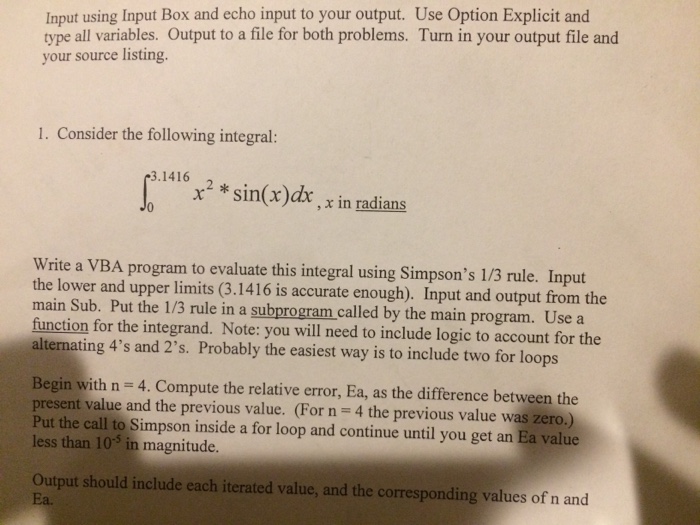
Show transcribed image text Input using Input Box and echo input to your output. Use Option Explicit and type all variables. Output to a file for both problems. Turn in your output file and your source listing. 1. Consider the following integral: 3.1416 x2 * sin(x)dx , x in radians Write a VBA program to evaluate this integral using Simpson's 1/3 rule. Input the lower and upper limits (3.1416 is accurate enough). Input and output from the main Sub. Put the 1/3 rule in a subprogram called by the main program. Use a function for the integrand. Note: you will need to include logic to account for the alternating 4's and 2's. Probably the easiest way is to include two for loops Begin with n 4. Compute the relative error, Ea, as the difference between the present value and the previous value. (For n 4 the previous value was zero.) Put the call to Simpson inside a for loop and continue until you get an Ea value less than 10 in magnitude. Output should include each iterated value, and the corresponding values of n and Ea.
Input using Input Box and echo input to your output. Use Option Explicit and type all variables. Output to a file for both problems. Turn in your output file and your source listing. 1. Consider the following integral: 3.1416 x2 * sin(x)dx , x in radians Write a VBA program to evaluate this integral using Simpson's 1/3 rule. Input the lower and upper limits (3.1416 is accurate enough). Input and output from the main Sub. Put the 1/3 rule in a subprogram called by the main program. Use a function for the integrand. Note: you will need to include logic to account for the alternating 4's and 2's. Probably the easiest way is to include two for loops Begin with n 4. Compute the relative error, Ea, as the difference between the present value and the previous value. (For n 4 the previous value was zero.) Put the call to Simpson inside a for loop and continue until you get an Ea value less than 10 in magnitude. Output should include each iterated value, and the corresponding values of n and Ea.
ScholarMatic: Explanation & Answer
Your ready answer from a verified tutor is just a click away for as little as $14.99


Click Order Now to get 100% Original Answer Customized to your instructions!



