
|
|||||||||||||||||||||||||||||||||||||||||||||||||||||||||||||||||||||||||||||||
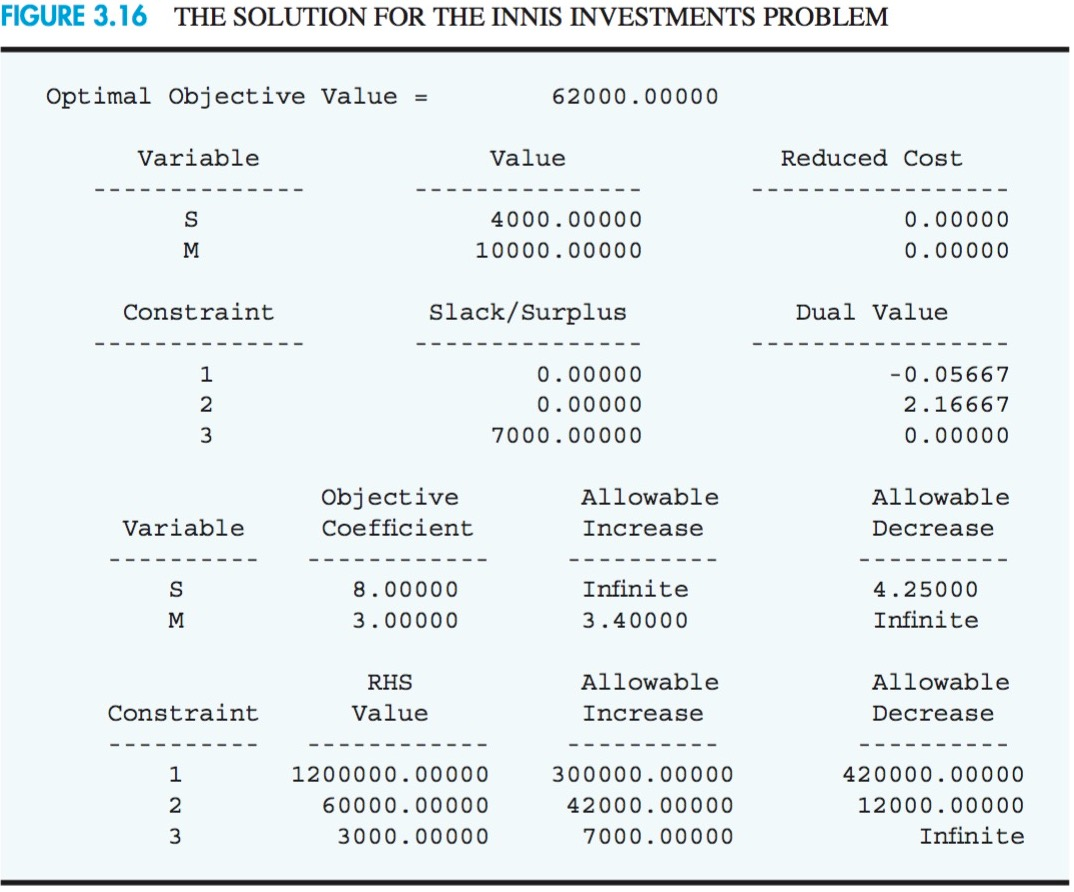 Refer to Figure 3.16.
a. (the value of CS) increases
from its currentvalue of 8 to 12. How does the optimal solution
change, if at all?
b. Suppose the risk index for the money market
fund (the value of CM) increases from its current
value of 3 to 3.5. How does the optimal solution change, if at
all?
c. Suppose CS increases to 12
and CM increases to 3.5. How does the optimal
solution change, if at all?
Show transcribed image text FIGURE 3.16 THE SOLUTION FOR THE INNIS INVESTMENTS PROBLEM Optimal objective value = 62000.00000 Variable Value Reduced Cost 4000.00000 10000.00000 0.00000 0.00000 Constraint Slack/Surplus Dual Value 1 2 0.00000 0.00000 7000.00000 0.05667 2.16667 0.00000 Objective Coefficient Allowable Increase Allowable Decrease Variable 8.00000 3.00000 Infinite 3.40000 4.25000 Infinite RHS Value Allowable Increase Allowable Decrease Constraint 1 2 1200000.00000 60000.00000 3000.00000 300000.00000 42000.00000 7000.00000 420000.00000 12000.00000 Infinite
FIGURE 3.16 THE SOLUTION FOR THE INNIS INVESTMENTS PROBLEM Optimal objective value = 62000.00000 Variable Value Reduced Cost 4000.00000 10000.00000 0.00000 0.00000 Constraint Slack/Surplus Dual Value 1 2 0.00000 0.00000 7000.00000 0.05667 2.16667 0.00000 Objective Coefficient Allowable Increase Allowable Decrease Variable 8.00000 3.00000 Infinite 3.40000 4.25000 Infinite RHS Value Allowable Increase Allowable Decrease Constraint 1 2 1200000.00000 60000.00000 3000.00000 300000.00000 42000.00000 7000.00000 420000.00000 12000.00000 Infinite
ScholarMatic: Explanation & Answer
Your ready answer from a verified tutor is just a click away for as little as $14.99


Click Order Now to get 100% Original Answer Customized to your instructions!



