
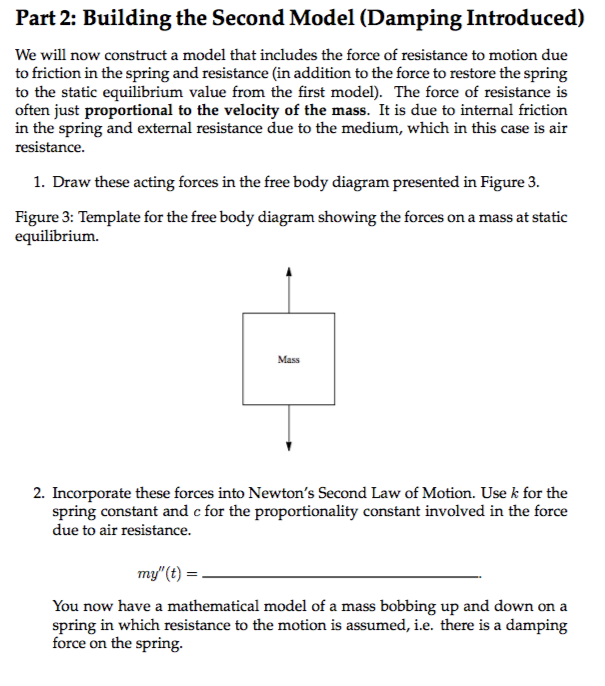
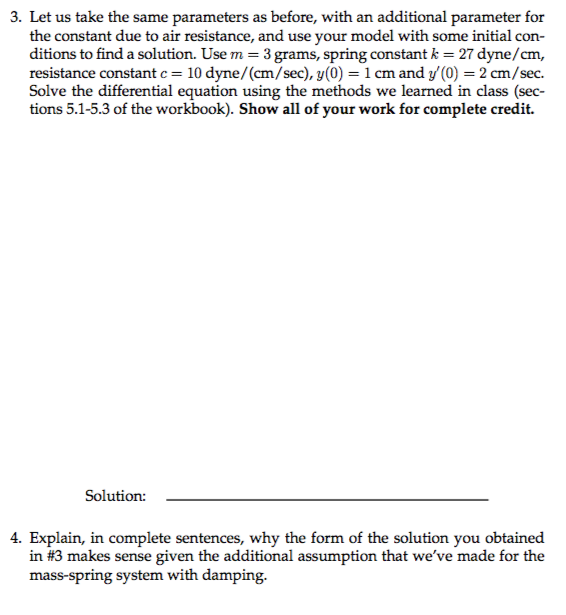
Part 2: Building the Second Model (Damping Introduced) We will now construct a model that includes the force of resistance to motion due to friction in the spring and resistance (in addition to the force to restore the spring to the static equilibrium value from the first model). The force of resistance is often just proportional to the velocity of the mass. It is due to internal friction in the spring and external resistance due to the medium, which in this case is air resistance. 1. Draw these acting forces in the free body diagram presented in Figure 3 Figure 3: Template for the free body diagram showing the forces on a mass at static equilibrium. Mass 2. Incorporate these forces into Newton’s Second Law of Motion. Use k for the spring constant and c for the proportionality constant involved in the force due to air resistance. my”(t) = You now have a mathematical model of a mass bobbing up and down on a spring in which resistance to the motion is assumed, i.e. there is a damping force on the spring.
ScholarMatic: Explanation & Answer
Your ready answer from a verified tutor is just a click away for as little as $14.99


Click Order Now to get 100% Original Answer Customized to your instructions!



