
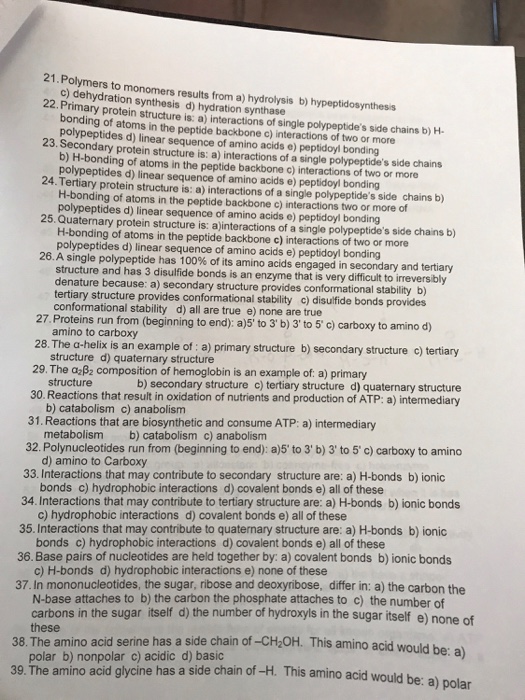
Polymers monomers results hydrolysis a) hydrolysis b) hypeptidosynthesis c) dehydration synthesis d) hydration synthase Primary protein structure is: a) interactions of a single polypeptide’s side chains b) H-bonding of atoms in the peptide backbone c) interactions of two or more polypeptides d) linear sequence of amino acids e) peptidoyl bonding Secondary protein structure is: a) interactions of a single polypeptide’s side chains b) H-bonding of atoms in the peptide backbone c) interactions two or more of polypeptides d) linear sequence of amino acids e) peptidoyl bonding Tertiary protein structure is: a)interactions of a single polypeptide’s side chains b) H-bonding of atoms in the peptide backbone c) interactions of two or more of polypeptides d) linear sequence of amino acids e) peptidoyl bonding Quaternary protein structure is: a)interactions of a single polypeptide’s side chains b) H-bonding of atoms in the peptide backbone c) interactions of two or more of polypeptides d) linear sequence of amino acids e) peptidoyl bonding A single polypeptide has 100% of its amino acids engaged in secondary and tertiary structure and has 3 disulfide bonds is an enzyme that is very difficult to irreversibly denature because: a) secondary structure provides conformational stability b) tertiary structure provides conformational stability c) disulfide bonds provides conformational stability d) are true e) none are true Proteins run from (beginning to end): a)5′ to 3′ b) 3′ to 5′ c) carboxy to amino d) amino to carboxy The alpha-helix is an example of: a) primary structure b) secondary structure c) tertiary structure d) quaternary structure The alpha_2 beta_2 composition of hemoglobin an example of: a) primary structure b) secondary structure c) tertiary structure d) quaternary structure Reactions that result in oxidation nutrients and production of ATP: a) intermediary b) catabolism c) anabolism Reactions that are biosynthetic and consume ATP: a) intermediary metabolism b) catabolism c) anabolism Polynucleotides run from (beginning to end): a)5′ to 3′ b) 3′ to 5′ c) carboxy to amino d) amino to Carboxy Interactions that may contribute to secondary structure are: a) H-bonds b) ionic bonds c) hydrophobic interactions d) covalent bonds e) all of these Interactions that may contribute to tertiary structure are: a) H-bonds b) ionic bonds c) hydrophobic interactions d) covalent bonds e) all of these Interactions that may contribute to quaternary structure are: a) H-bonds b) ionic bonds c) hydrophobic interactions d) covalent bonds e) all of these Base pairs of nucleotides are held together by: a) covalent bonds b) ionic bonds c) H-bonds d) hydrophobic interactions e) none of these In mononucleotides, the sugar, ribose and deoxyribose, differ in: a) the carbon the N-base attaches to b) the carbon the phosphate attaches to c) the number of these in the sugar itself d) the number of hydroxyls in the sugar itself e) none of these This amino acid serine has a side chain of -CH_2OH. This amino acid would be: a) polar b) nonpolar c) acidic d) basic This amino acid glycine has a side chain of -H. The amino acid would be: a) polar
ScholarMatic: Explanation & Answer
Your ready answer from a verified tutor is just a click away for as little as $14.99


Click Order Now to get 100% Original Answer Customized to your instructions!



