
text version:
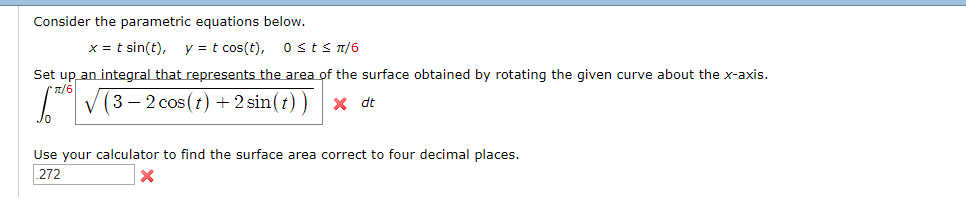
Consider the parametric equations below.
x = t
sin(t), y = t
cos(t), 0 ≤ t ≤
π/6
Set up an integral that represents the area of the surface
obtained by rotating the given curve about the x-axis.
| π/6 |
√(3−2cos(t)+2sin(t)) dt |
 |
|
| 0 |
Use your calculator to find the surface area correct to four
decimal places.
Show transcribed image text Consider the parametric equations below x=t sin(t), y=t cos(t), 0 t T/6 Set up an integral that represents the area of the surface obtained by rotating the given curve about the x-axis. V (3-2 cos(t) +2sin(t)) x dt 一2COS Use your calculator to find the surface area correct to four decimal places 272
Consider the parametric equations below x=t sin(t), y=t cos(t), 0 t T/6 Set up an integral that represents the area of the surface obtained by rotating the given curve about the x-axis. V (3-2 cos(t) +2sin(t)) x dt 一2COS Use your calculator to find the surface area correct to four decimal places 272
ScholarMatic: Explanation & Answer
Your ready answer from a verified tutor is just a click away for as little as $14.99


Click Order Now to get 100% Original Answer Customized to your instructions!



