
What is the population in the study?
– the 34% of new words mistakenly identified as original words
because they were conceptually similar
– the 500 first-year students in college
– the 50 students who participated in the study
What is the sample in the study?
– the 34% of new words mistakenly identified as original words
because they were conceptually similar
-the 50 students
– the 500 students
What is an example of a statistic in the study?
-34%, the average percentage of conceptually similar words
mistakenly thought to be on the original list by the 50
students
-232 females and 268 males
– 34%, the average percentage of the conceptually similar words
expected to be mistaken as being on the original list by the 500
students
What is an example of a perimeter in the study?
– the actual average percentage of conceptually similar words that
would be mistakenly recognized as being from the original list by
the 500 first-year students
-34% of new but conceptually similar words that were mistakenly
thought to be on the original list by the 50 first-year
students
-50 students
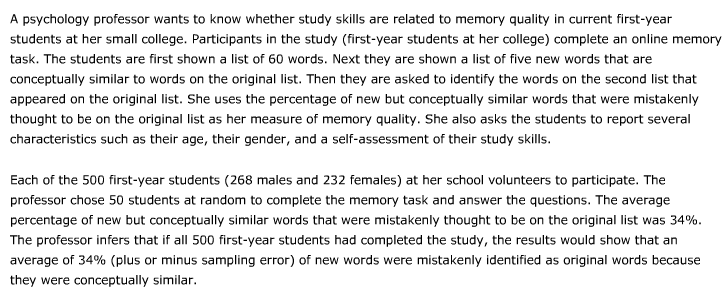
Show transcribed image text A psychology professor wants to know whether study skills are related to memory quality in current first-year students at her small college. Participants in the study (first-year students at her college) complete an online memory task. The students are first shown a list of 60 words. Next they are shown a list of five new words that are conceptually similar to words on the original list. Then they are asked to identify the words on the second list that appeared on the original list. She uses the percentage of new but conceptually similar words that were mistakenly thought to be on the original list as her measure of memory quality. She also asks the students to report several characteristics such as their age, their gender, and a self-assessment of their study skills Each of the 500 first-year students (268 males and 232 females) at her school volunteers to participate. The professor chose 50 students at random to complete the memory task and answer the questions. The average percentage of new but conceptually similar words that were mistakenly thought to be on the original list was 34% The professor infers that if all 500 first-year students had completed the study, the results would show that an average of 34% (plus or minus sampling error) of new words were mistakenly identified as original words because they were conceptually similar
A psychology professor wants to know whether study skills are related to memory quality in current first-year students at her small college. Participants in the study (first-year students at her college) complete an online memory task. The students are first shown a list of 60 words. Next they are shown a list of five new words that are conceptually similar to words on the original list. Then they are asked to identify the words on the second list that appeared on the original list. She uses the percentage of new but conceptually similar words that were mistakenly thought to be on the original list as her measure of memory quality. She also asks the students to report several characteristics such as their age, their gender, and a self-assessment of their study skills Each of the 500 first-year students (268 males and 232 females) at her school volunteers to participate. The professor chose 50 students at random to complete the memory task and answer the questions. The average percentage of new but conceptually similar words that were mistakenly thought to be on the original list was 34% The professor infers that if all 500 first-year students had completed the study, the results would show that an average of 34% (plus or minus sampling error) of new words were mistakenly identified as original words because they were conceptually similar
ScholarMatic: Explanation & Answer
Your ready answer from a verified tutor is just a click away for as little as $14.99


Click Order Now to get 100% Original Answer Customized to your instructions!



